It’s Christmas Eve, twenty minutes before the 7 p.m. service. The lot filled up half an hour ago, the lobby is a crush of coats and strollers, and a third of the faces coming through the doors are ones nobody on the greeter team has seen before. One man comes in alone, skips the bulletin, and stands against the back wall with his eyes on the side exit.
Maybe he hasn’t been inside a church in years and feels out of place. Maybe something else is going on. Either way, the greeter who shook his hand is the person best placed to find out, kindly and early.
That’s the real job of greeters and ushers during the holidays. You’re the welcome, and you’re also the first set of eyes on everyone who walks in. This checklist helps your team do both.
On an ordinary Sunday, your greeters know most of the people coming in. That familiarity is a quiet safety system: when someone doesn’t fit, a regular notices. Holiday services break that system in several ways at once.
- Bigger, unfamiliar crowds. Visitors, returning family, and first-timers make it harder to tell who belongs and who doesn’t.
- More open doors. Overflow seating, extra services, children’s programs, and fellowship-hall events often mean side doors stay unlocked longer than usual.
- Darkness. Evening and midnight services in a Massachusetts December mean people arrive and leave in the dark, across icy lots.
- Stretched volunteers. Regular greeters may be serving at multiple services, and fill-ins may not know the routine.
- High emotions. Holidays bring grief, loneliness, and family conflict. Sometimes a dispute that started at home follows someone to church.
The most likely emergency is medical, not violent. A crowded, warm sanctuary, a long service, and many older guests add up to fainting, falls, and the occasional cardiac event. A good greeter and usher team is ready for both, and much of the preparation is the same.
Print this, walk through it with your team in the week before the holidays, and keep a copy at the welcome desk.
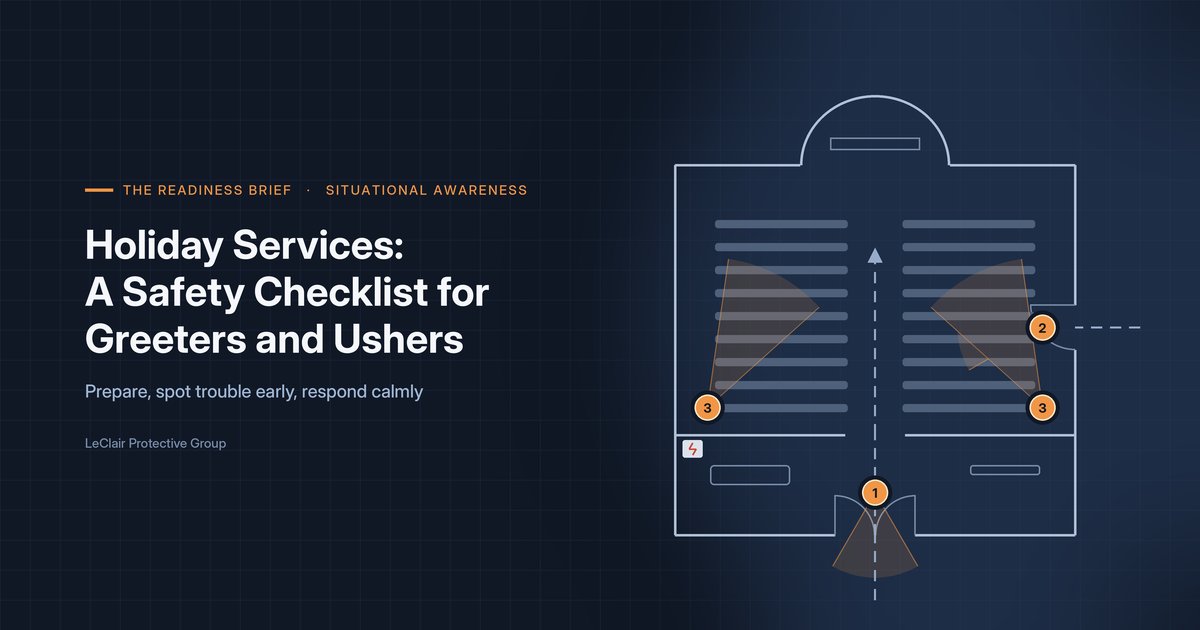
☐ Hold a 15-minute huddle. Assign a position for every open door, the back of the sanctuary, and the children’s wing. Name one point person per service who decides when to call for help.
☐ Walk the building. Decide which doors will be open and which stay closed once the service starts. Make sure overflow chairs don’t block aisles or exits, and check that the parking lot and walkways are lit.
☐ Find the AED and first aid kit. Confirm everyone knows where they are, that the AED’s status light shows it’s ready, and who on each shift is CPR-trained.
☐ Agree on how you’ll communicate. Radios or a group text both work. Use plain language (“I need an usher at the east door”) rather than codes nobody remembers. Post the church’s street address at the welcome desk for 911 calls.
☐ Review children’s check-in and pickup. Holiday crowds blur who is picking up whom. Make sure volunteers know the release rules and who to call if something doesn’t match.
☐ Greet every single person. Eye contact, a handshake, and a simple question (“First time with us?”) are hospitality. They also give you a read on everyone who comes in.
☐ Watch behavior, not appearance. Notice someone who avoids every greeter, keeps scanning the exits or the crowd instead of the service, lingers near the children’s area, or is visibly agitated. A member who tells you they’re afraid of someone who just arrived deserves immediate attention.
☐ Keep one entrance staffed after the service starts. Late arrivals are welcome. Have them come through a door someone is watching.
☐ Keep aisles clear. Ushers should be able to reach any row quickly, and so should paramedics.
☐ Post people at the exits and in the lot. The crowd leaving in the dark is when slips, fender-benders, and arguments happen. Walk staff and volunteers to their cars.
☐ Sweep the building before you lock up. Check restrooms, classrooms, and the fellowship hall.
☐ Debrief for ten minutes. What happened, what was confusing, and what should change before the next service? Write it down.
Most concerns turn out to be nothing: a nervous visitor, a parent looking for a lost child, someone having a hard night. The way you respond should fit that reality while keeping you ready if it’s more.
- Lead with hospitality. Walk over and offer help: “Can I find you a seat?” or “Is there someone you’re looking for?” A friendly conversation settles most situations and tells you a lot about the ones it doesn’t.
- Never go alone. Bring a second greeter or usher, and let your point person know where you are.
- Give space. Stand at an angle, keep an arm’s length or more, and never block the person’s way out. Speak calmly and keep your hands visible.
- Don’t confront or restrain. Your role is to notice, connect, and alert, not to win an argument or put hands on anyone.
- Call 911 when there’s a threat. If someone shows a weapon, makes a threat, or turns violent, call immediately. Nobody needs permission.
If someone collapses, the steps are just as clear. Call 911 and send a specific person for the AED. If the person is unresponsive and not breathing normally, start CPR. Have another usher clear the aisle and a third wait at the main door to guide paramedics in. See What a Workplace Security Assessment Covers for how medical readiness fits into a full safety review.
A checklist tells your team what to do. Practice is what makes them do it calmly when the lobby is packed and something doesn’t feel right. LeClair Protective Group’s situational awareness training for greeter and usher teams covers how to read behavior, what to say when you approach someone, how to signal each other, and when to call for help, with realistic scenarios run in your own building. It pairs naturally with American Heart Association CPR and AED certification, so the same volunteers are ready for a medical emergency too.
Training is led by Rick LeClair, a Massachusetts State Police certified firearms instructor, American Heart Association CPR instructor, and longtime martial arts and self-defense teacher.
Want your team ready before the holidays? Request a consultation and we’ll find a time to train your greeters and ushers on site.